Robotic vs Open Cancer Surgery: Which Is Better and When?
Robotic or open? A surgeon’s honest comparison of robotic vs open cancer surgery — recovery, cost, outcomes, and when each approach is the right choice.
Get a free second opinion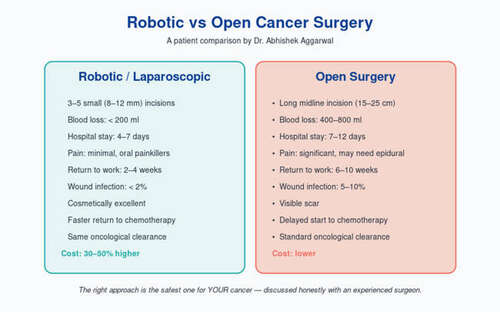
Robotic or open? A surgeon’s honest comparison of robotic vs open cancer surgery — recovery, cost, outcomes, and when each approach is the right choice.
Robotic surgery has become one of the most talked-about innovations in Indian healthcare. Hospitals advertise it, patients ask for it by name, and the term itself has become shorthand for ‘the most modern treatment.’ But what does robotic surgery actually offer the cancer patient, and when is a traditional open operation still the better choice? As a surgeon who performs both, I can tell you the honest answer is more nuanced than the marketing suggests. Robotic surgery is not automatically better. Open surgery is not automatically outdated. The right choice depends on the type of cancer, its location, the patient’s anatomy, and — crucially — the experience of the surgical team. This article lays out the real trade-offs.
What robotic surgery actually is
Robotic surgery is a form of minimally invasive surgery. The surgeon sits at a console a few feet from the patient, controlling four robotic arms that hold the camera and instruments. The arms enter the body through small keyhole incisions. The robot does not make decisions; every movement is a direct translation of the surgeon’s hands — only steadier, scaled down, and filtered of tremor. The camera provides high-definition 3D vision with magnification up to ten times.
Think of it this way: robotic surgery is to laparoscopic surgery what an automatic car is to a manual one. It gives the surgeon more precision in difficult spaces, particularly deep in the pelvis or near major blood vessels. It does not replace surgical judgment; it amplifies it.
Where robotic surgery genuinely shines
Certain cancer operations benefit meaningfully from the robotic approach. Rectal cancer surgery, particularly low anterior resection, is the standout example. The confined space of the male pelvis is exactly where the robot’s precision helps most, and international data now support better nerve preservation, faster recovery, and lower transfusion rates in experienced hands.
Other operations where robotics offers real advantages include: prostate cancer (urology), radical hysterectomy for cervical cancer, complex oesophagectomy, and select liver and pancreatic resections. In all of these, the common thread is deep, confined anatomy where traditional straight instruments struggle.
Where open surgery is still the right answer
For large tumours, advanced disease, complex vascular involvement, or patients with extensive previous surgery, open surgery remains the standard. Cytoreductive surgery with HIPEC, most stomach cancer operations with extensive lymph node dissection, and many primary liver resections are examples where an open approach gives the surgeon better control and faster management of unexpected findings.
Equally, a skilled open surgeon routinely achieves outcomes as good as — or better than — a moderately experienced robotic surgeon. The surgeon’s experience matters more than the technology. An inexperienced robotic surgeon is not safer than an experienced open one; the opposite may be true.
Cost — the honest breakdown
Robotic surgery in India is generally 20–40% more expensive than the equivalent open operation. The additional cost covers the disposable instruments (each used for only 10 cases), the amortized cost of the robot, and higher OT charges. For major cancer operations at private hospitals, expect an additional ₹1.5–3 lakh over the open equivalent.
Is it worth it? In select cases — rectal cancer, prostate cancer — yes, the evidence supports the additional cost. For other cancers, the advantage is real but smaller, and patients should weigh it against financial reality. Insurance coverage for robotic surgery is expanding in India but still inconsistent; always confirm with your insurer before admission.
How to make the right choice
Four practical questions should guide your decision. One: for my specific cancer, what is the recommended approach at high-volume international centers? Your surgeon should be able to cite published guidelines. Two: how many robotic operations of my type has my surgeon performed? The learning curve for robotic cancer surgery is steep — ask for numbers, not reassurance. Three: what is the all-inclusive cost difference, and what do I gain in return? Four: what is the backup plan if conversion to open surgery becomes necessary mid-operation? A good surgeon discusses this openly.
The truth about robotic versus open surgery is that both are tools. The cancer, the patient, and the surgeon together determine the right one. A confident surgeon will recommend whichever approach gives you the best oncological outcome — not the one the hospital wants to market.
Frequently Asked Questions
Is robotic surgery safer than open surgery?
Not automatically. Safety depends on surgeon experience, case complexity, and appropriate patient selection. For the right cancer in experienced hands, robotic surgery has real advantages; for the wrong case, it can be worse.
Does robotic surgery cure cancer better?
For most cancers, long-term oncological outcomes are equivalent between robotic and open surgery. The key determinants of cure are complete tumour removal, adequate lymph node clearance, and appropriate adjuvant therapy — not the tool used.
Is recovery really faster after robotic surgery?
In many cases, yes — usually by 2–4 days in hospital stay and 1–2 weeks in return to work, depending on the operation. The benefit is most noticeable for pelvic and thoracic procedures.
Does insurance cover robotic surgery in India?
Most major insurers now cover robotic cancer surgery, but policies vary. Always get pre-authorization in writing before admission, and confirm whether the robotic supplement is included.
Consult Dr. Abhishek Aggarwal
Associate Director — GI, HPB & Cancer Surgery

Meet Dr. Abhishek Aggarwal
Dr. Abhishek Aggarwal is a highly skilled GI & HPB surgeon with over 10 years of experience in managing complex gastrointestinal and hepato-pancreato-biliary diseases, with a special focus on oncological surgery. He currently serves as Associate Director – GI Oncosurgery at BLK-Max Super Speciality Hospital, where he is actively involved in delivering advanced surgical care for GI and HPB malignancies.
He has trained and worked in reputed high-volume centres, gaining extensive expertise in complex oncological procedures and multidisciplinary cancer care. His clinical practice is firmly grounded in scientific, evidence-based medicine, ensuring that patients receive treatment aligned with the latest global standards and research.
OPD Timing: 09:00 AM – 05:00 PM
Contact Dr. Abhishek →