10 Questions to Ask Your GI Cancer Surgeon Before Surgery
Before you consent to cancer surgery, ask these 10 questions. A surgeon’s guide to preparing for your consultation and making the best decision for your care.
Get a free second opinion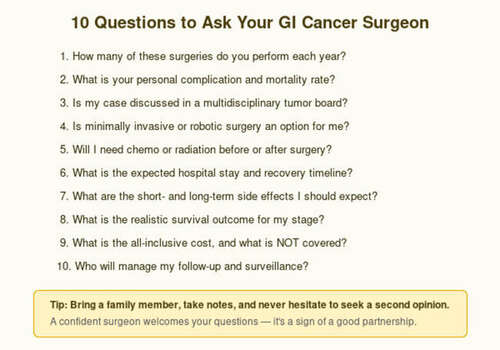
Before you consent to cancer surgery, ask these 10 questions. A surgeon’s guide to preparing for your consultation and making the best decision for your care.
A cancer surgery consultation is one of the most important conversations of your life — and also one of the most overwhelming. Between the diagnosis, the medical terminology, the emotional weight, and the pressure to decide quickly, most patients leave the surgeon’s office realizing later that they forgot to ask the things that mattered most. As a GI cancer surgeon, I encourage every patient to come prepared with a written list of questions. A confident surgeon welcomes them — it is a sign of a patient who is engaged in their own care, and an engaged patient is invariably a better-prepared one. Here are the 10 questions I would want my own family to ask, in the order they should be asked, and why each one matters.
Questions 1–3: experience and team
1. How many of these specific operations do you perform each year? The volume–outcome relationship is one of the most robust findings in all of surgery. For complex operations like the Whipple, centers performing more than 25 cases per year have mortality rates several-fold lower than low-volume centers. Do not be shy about asking for the number. ‘Several’ is not an answer.
2. What is your personal complication rate and 30-day mortality? Good surgeons track their outcomes and will share them with you. The numbers do not have to be zero — complications are part of complex surgery — but they should be in line with published international benchmarks for your specific procedure.
3. Is my case being discussed in a multidisciplinary tumour board? Modern cancer care is a team sport. Your case should be reviewed by surgeons, medical oncologists, radiation oncologists, radiologists, and pathologists together, not decided by one doctor alone. If there is no tumour board, seek a second opinion.
Questions 4–6: the operation itself
4. Is minimally invasive or robotic surgery an option for me, and if so, is it the right choice? Not every cancer is suitable for a minimally invasive approach, and not every surgeon is experienced in robotics. Ask for an honest comparison of open versus minimally invasive options for your specific tumour.
5. Will I need chemotherapy or radiation before or after surgery? For many GI cancers, the optimal treatment plan involves more than just the operation. Neoadjuvant chemotherapy (before surgery) is increasingly standard for pancreatic, gastric, and rectal cancers. Adjuvant treatment (after surgery) may also be needed. Ask for the full plan, not just the surgical part.
6. What is the expected hospital stay and recovery timeline? This helps you plan realistically for work, family support, and finances. Be aware that the ‘typical’ stay assumes no complications; ask what happens if things do not go to plan.
Questions 7–9: outcomes, cost, and aftercare
7. What are the short- and long-term side effects I should expect? Every major cancer operation has predictable side effects — dumping after gastrectomy, diabetes after Whipple, bowel habit changes after colorectal surgery. Knowing them in advance helps you prepare emotionally and practically.
8. What is the realistic survival outcome for my stage and tumour type, in the honest experience of this center? General statistics from the internet are not a substitute for your surgeon’s honest estimate. A good surgeon will give you a range, acknowledge the uncertainty, and be neither falsely optimistic nor unnecessarily grim.
9. What is the all-inclusive cost of the treatment, and what is not included? Get this in writing. The headline package price rarely covers everything. Ask specifically about chemotherapy, ICU days, blood products, and complication management.
Question 10 and the meta-question
10. Who will manage my follow-up and surveillance, and for how long? Cancer surgery is not the end — it is the middle. Regular scans, blood tests, and clinic visits are needed for at least five years afterward. Know who will coordinate this, especially if you are travelling for treatment.
And finally, the meta-question: if this were your own family member, would you recommend exactly the same treatment at exactly this center? A truly confident surgeon will answer without hesitation. If you sense any discomfort with this question, trust your instinct and seek a second opinion. Good doctors welcome second opinions — we all get them for ourselves and our families.
How to actually use this list
Print the questions. Take them to the consultation. Bring a family member, because two people hear more than one. Ask the surgeon’s permission to take notes or, better, to record the conversation — most will agree. If anything is unclear, ask again in different words. There are no stupid questions in cancer care, only questions you wished you had asked later.
The goal of this list is not to turn you into a suspicious patient. It is to help you find a surgeon you can genuinely trust, because a trusting relationship with your surgical team is one of the most important non-medical factors in a good outcome. When the answers are open, specific, and confident, you have found the right place. When they are vague or defensive, keep looking.
Frequently Asked Questions
Is it rude to ask my surgeon for their complication rates?
Not at all. It is a normal, reasonable question, and a good surgeon is happy to answer it. Surgeons who track their outcomes are invariably better than those who do not.
Should I always get a second opinion for cancer surgery?
Yes — particularly for major operations like Whipple, oesophagectomy, and HIPEC. A second opinion at a high-volume center can confirm your plan or meaningfully change it. Either way, you gain confidence.
What if my surgeon seems offended by my questions?
That is a red flag. Good surgeons welcome engaged patients. If your surgeon is dismissive or defensive, seek care elsewhere.
Can I bring a family member into the consultation?
Absolutely — and you should. A second set of ears catches details you will miss, and emotional support matters in these conversations.
Consult Dr. Abhishek Aggarwal
Associate Director — GI, HPB & Cancer Surgery

Meet Dr. Abhishek Aggarwal
Dr. Abhishek Aggarwal is a highly skilled GI & HPB surgeon with over 10 years of experience in managing complex gastrointestinal and hepato-pancreato-biliary diseases, with a special focus on oncological surgery. He currently serves as Associate Director – GI Oncosurgery at BLK-Max Super Speciality Hospital, where he is actively involved in delivering advanced surgical care for GI and HPB malignancies.
He has trained and worked in reputed high-volume centres, gaining extensive expertise in complex oncological procedures and multidisciplinary cancer care. His clinical practice is firmly grounded in scientific, evidence-based medicine, ensuring that patients receive treatment aligned with the latest global standards and research.
OPD Timing: 09:00 AM – 05:00 PM
Contact Dr. Abhishek →