Whipple's Procedure
Pancreaticoduodenectomy — the curative operation for cancers of the pancreatic head and periampullary region, performed by a specialist team.
What is the Whipple Procedure?
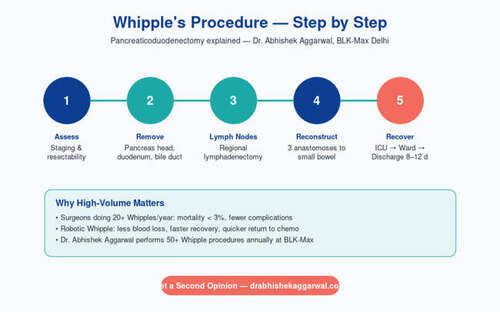
The Whipple procedure (formally pancreaticoduodenectomy) is one of the most complex operations in abdominal surgery. It removes the head of the pancreas, the duodenum, the gallbladder, the lower bile duct, and nearby lymph nodes — then reconstructs the digestive tract with three separate anastomoses.
Who needs a Whipple?
- Pancreatic head adenocarcinoma
- Ampullary cancer
- Distal bile duct cancer (cholangiocarcinoma)
- Duodenal cancer
- Selected benign tumours and cystic neoplasms
Why surgeon volume matters
Mortality after Whipple at centres doing fewer than 10 per year exceeds 10–15%. At specialist high-volume centres the rate is under 3%. Choosing an experienced HPB surgeon is the single most important decision a patient can make.
Frequently Asked Questions
Answers to the most common questions about Whipple’s Procedure.
How long does a Whipple surgery take?
A standard Whipple procedure takes approximately 5–7 hours at an experienced centre. Robotic Whipple may take slightly longer. The operation involves two phases: resection (removal) and reconstruction (joining the remaining organs).
What is the mortality rate of the Whipple?
At specialist high-volume centres like ours, 30-day mortality is under 3%. At low-volume hospitals it can exceed 10–15%. Surgeon experience and hospital volume are the single biggest determinants of safety.
How long will I be in hospital?
Typical stay after a successful Whipple is 10–12 days at our centre — 3–4 days in high-dependency care followed by 6–8 days on the ward. Complications can extend this.
Will I need insulin after a Whipple?
Not usually. Only the head of the pancreas is removed, and most patients retain enough pancreatic function to avoid diabetes. Some patients develop mild glucose intolerance that can be managed without insulin.
Will I need pancreatic enzymes after surgery?
Yes, most patients need oral pancreatic enzyme supplements with meals for at least the first 6–12 months, and sometimes long-term. This helps digestion and prevents weight loss.
What are the main complications?
The most significant complication is pancreatic fistula (leakage from the pancreatic join) which occurs in 10–15% of cases. Most fistulas heal with conservative management. Other risks include delayed gastric emptying, bleeding, and infection.
Can a Whipple be done robotically?
Yes, robotic Whipple is increasingly performed by experienced HPB surgeons. Dr. Abhishek performs robotic Whipple in carefully selected patients, offering less blood loss and faster recovery when appropriate.
What is the recovery timeline?
Most patients return to light activities within 4–6 weeks and full recovery by 3 months. Chemotherapy typically starts 6–8 weeks after surgery and continues for 6 months.
How do I prepare for a Whipple?
Preparation includes nutritional optimisation, managing diabetes and jaundice, stopping certain medications, and physiotherapy. Our team coordinates all pre-operative planning to ensure the best possible starting condition.
Is the Whipple covered by insurance?
Yes, most health insurance policies in India cover Whipple surgery. We assist with pre-authorisation and provide detailed cost estimates. Cash estimates at BLK-Max typically range ₹5–8 lakh depending on technique and room category.

Meet Dr. Abhishek Aggarwal
Dr. Abhishek Aggarwal is a highly skilled GI & HPB surgeon with over 10 years of experience in managing complex gastrointestinal and hepato-pancreato-biliary diseases, with a special focus on oncological surgery. He currently serves as Associate Director – GI Oncosurgery at BLK-Max Super Speciality Hospital, where he is actively involved in delivering advanced surgical care for GI and HPB malignancies.
He has trained and worked in reputed high-volume centres, gaining extensive expertise in complex oncological procedures and multidisciplinary cancer care. His clinical practice is firmly grounded in scientific, evidence-based medicine, ensuring that patients receive treatment aligned with the latest global standards and research.
OPD Timing: 09:00 AM – 05:00 PM
Contact Dr. Abhishek →